Give the two dimensions different names
Overall length is the end-to-end size of the handle. Hole-center spacing is the distance between the centers of its two fixing holes. Write both names on a small drawing. A listing that displays only the overall length has not yet answered whether the new handle fits your existing front.
Measure the existing arrangement
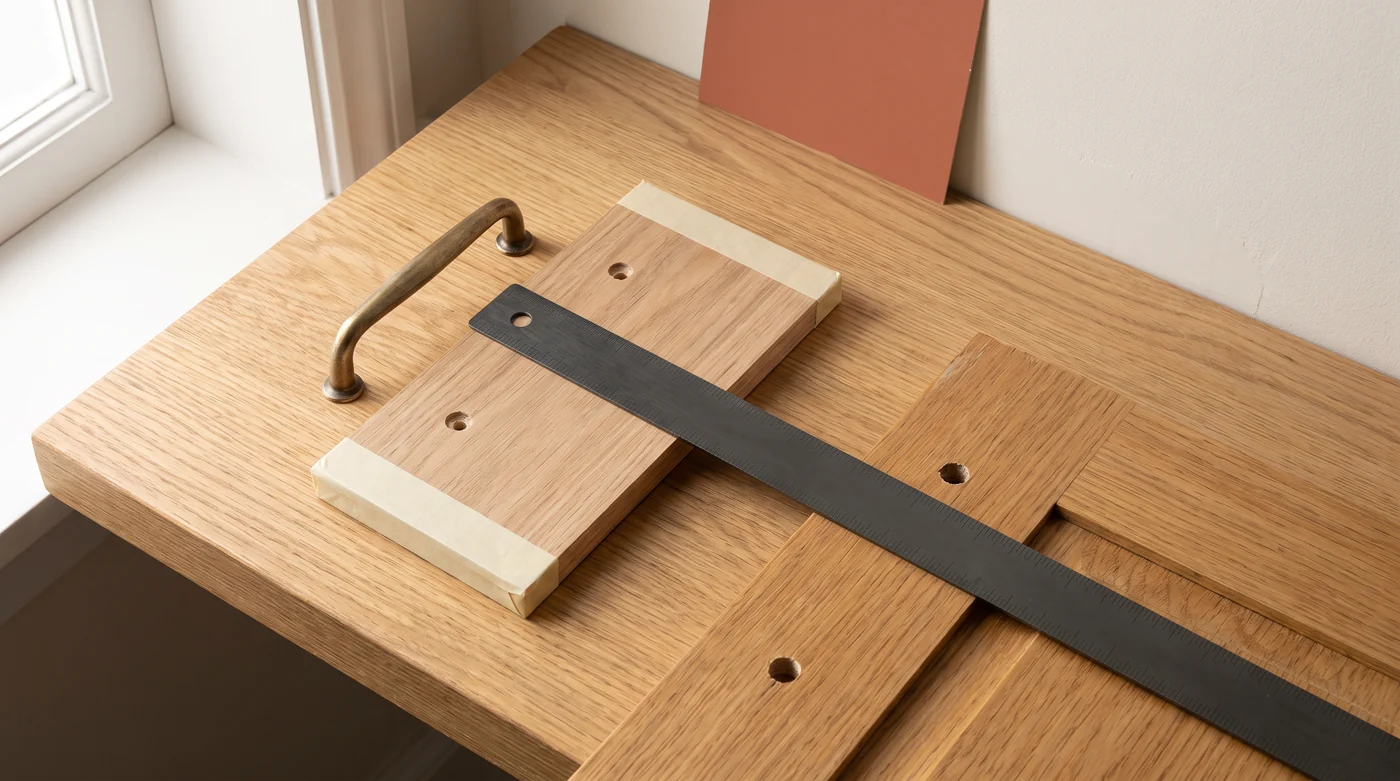
Use the same unit system as the replacement drawing. Read from the center of one fixing position to the center of the other, rather than from one outside edge to another. Repeat the reading and keep a photograph showing the points. If the holes are damaged or elongated, record that instead of presenting the measurement as a precise fit specification.
Check the dimensions around the holes
Projection affects the room for fingers and potential contact with adjacent fronts or appliances. Door or drawer-front thickness affects the suitable fastening arrangement. Compare the replacement manufacturer’s drawing and supplied hardware information, including the usable fastener length. Matching the two holes is necessary, but it does not answer every fit question.
Try the purchasing record on one location
Choose a representative drawer or door and keep its dimensions with the exact replacement reference. Where the cabinets vary, label each group rather than assuming all fronts are the same. After a compatible sample has been checked under its instructions, use that record for the remaining purchase.
Keep substrate identification, product instructions, measurements, preparation photographs and observed results together. We do not turn a generic checklist into a structural or installation specification.